Blog

  • U.S. deploys bulk of stealthy long-range missile for Iran war

    U.S. deploys bulk of stealthy long-range missile for Iran war


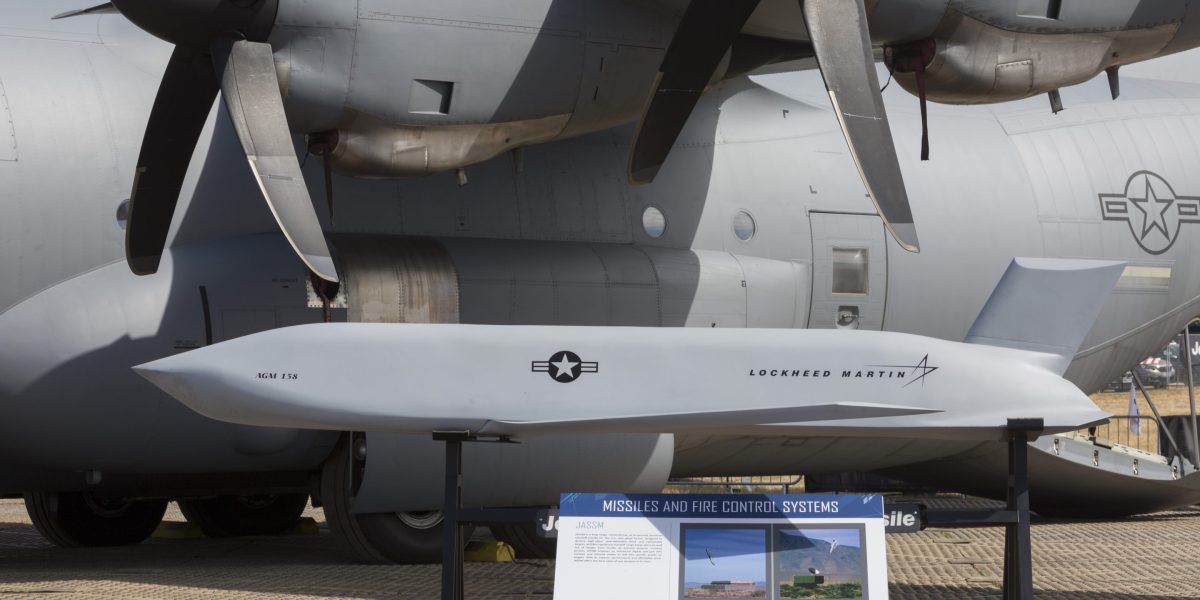
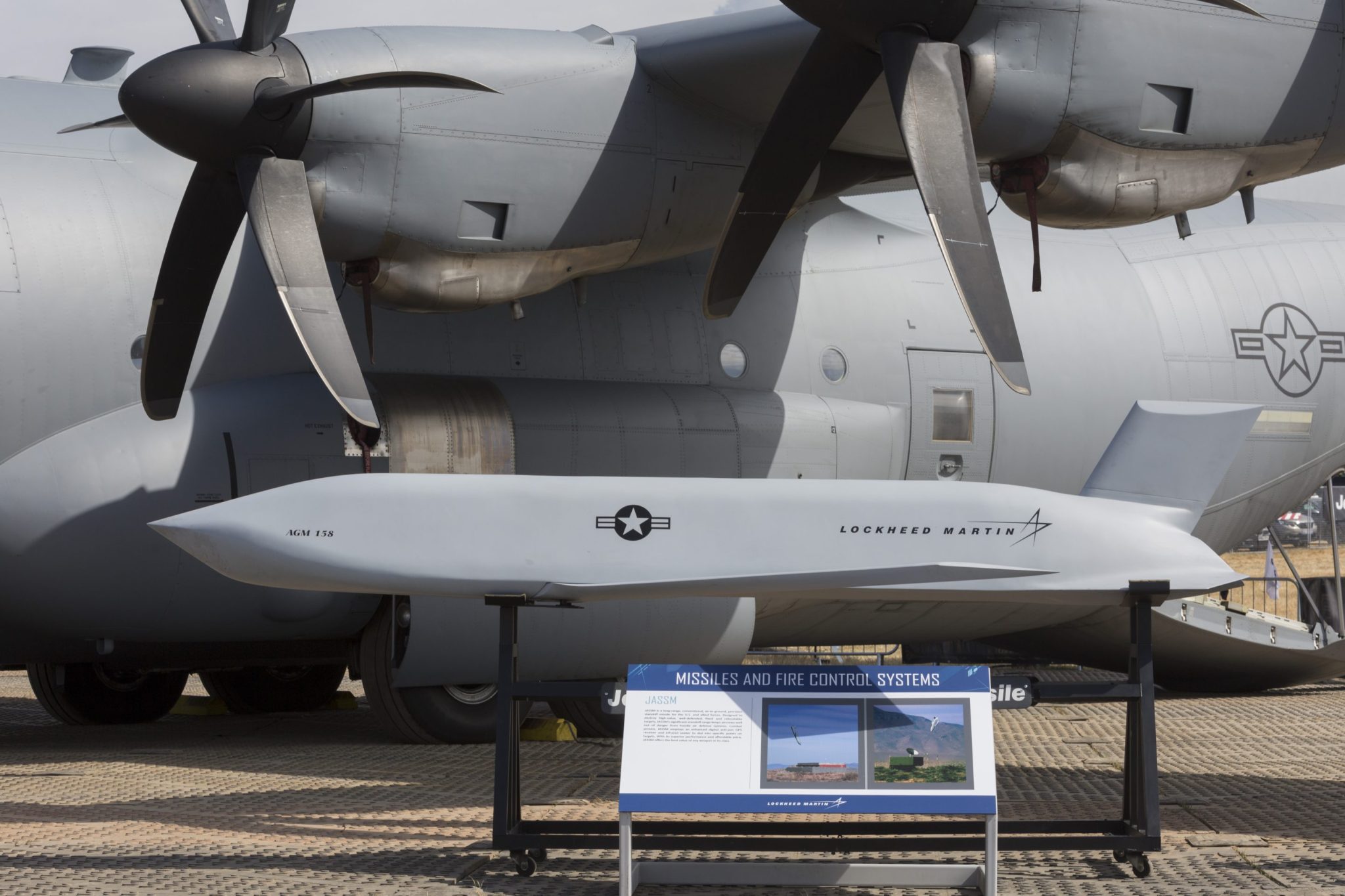
    The next steps in the US military campaign against Iran will commit nearly its entire inventory of stealthy JASSM-ER cruise missiles, drawing them from stockpiles devoted to other regions.

    The order to pull the $1.5 million weapon from Pacific stockpiles was issued at the end of March, according to a person with direct knowledge of the matter. Missiles at US facilities elsewhere, including the continental US, will be moved to US Central Command bases or Fairford in the UK, said the person, who was granted anonymity to discuss sensitive details.

    After the moves, only about 425 JASSM-ER out of a prewar inventory of 2,300 will remain available for the rest of the globe. That would be roughly enough for 17 B-1B bombers on a single mission. Another 75 or so are “unserviceable” because of damage or technical faults.

    The JASSM-ER, or Joint Air-to-Surface Missile-Extended Range, can fly more than 600 miles and was designed to hit targets at a safer distances to avoid an enemy’s air defenses. 

    Along with the shorter-range JASSM — which has a range of about 250 miles, about two-thirds of US stockpiles have been committed to the Iran war, the person said.

    Supplies of missile interceptors and long-range strike weapons have been at issue since the US and Israel launched their air campaign on Feb. 28. Replacing what has been used would take many years’ worth of production at current levels.

    Read More: Trump Warns Iran It Has 48 Hours Left as Airman Remains Missing

    The US has been using large numbers of long-range weapons like JASSM-ER for strikes, limiting the risk to service members but reducing stocks of systems meant for more capable adversaries such as China.

    The US and Israel have said they destroyed a significant portion of Iran’s air defenses, allowing them to use cheaper weapons to hit targets in the country. But a US F-15E strike fighter was shot down on Friday. Soon afterward, an A-10 attack jet was downed and two combat search-and-rescue helicopters were hit by Iranian fire, the New York Times reported.

    US operations through the first four weeks of the war consumed more than 1,000 JASSM-ERs, the person said, speaking on condition of anonymity because of the sensitivity of the matter. US aircraft also fired 47 during the raid to capture Venezuelan President Nicolas Maduro, the person said.

    The US has allocated funds to buy more than 6,200 JASSMs since 2009, and production of the baseline JASSM for US supplies ended about 10 years ago.

    Lockheed Martin Corp.’s scheduled production rate for 2026 is 396 of the longer-range version, although as many as 860 can be manufactured if the line, which also produces the LRASM anti-ship missile, is fully geared toward JASSMs. 

    Committing so many JASSM-ERs to the Iran war does not mean they will all be used. So far they have been launched from B-52 and B-1B bombers, as well as strike fighters.

    US Central Command and the Department of Defense did not immediately respond to requests for comment.

    ‘Stone Ages’

    It’s not clear what President Donald Trump is planning next for the US campaign. As ground troops, including Marines and paratroopers, move to the region, speculation has swirled about seizing Kharg island, home to Iran’s main oil terminals.

    Trump said in a Wednesday night speech that “over the next two to three weeks, we’re going to bring them back to the stone ages where they belong,” without specifying what that meant for Iran’s civilians, military or government. 

    On Tuesday, Chairman of the Joint Chiefs General Dan Caine said the US had begun to fly B-52s over Iran, implying that airspace was now safer for attacks using cheaper and more plentiful JDAM precision bombs.

    But along with the two US planes downed on Friday, Iran has also destroyed more than 12 MQ-9 strike drones during the course of the war.  

    The fact that the older, slower B-52s were only now flying over Iran “raises questions about the degree to which the US has continued to rely on standoff capabilities,” said Kelly Grieco, a senior fellow at the Stimson Center.

    Iran has launched more than 1,600 ballistic missiles around the region, according to Gulf countries’ official reporting, and about 4,000 Shahed-type rudimentary cruise missiles. Defending against ballistic missiles alone would consume at least 3,200 interceptors.

    While Lockheed Martin makes about 650 Patriot PAC-3 interceptors per year, the company signed an agreement in January to make 2,000 a year by 2030. The company also makes 96 THAAD interceptors per year, but reached a separate deal to increase that number to 400.

    The US has fired hundreds of Tomahawk cruise missiles during the attack on Iran. There were about 4,000 Tomahawks in US stockpiles before the war — including older models and anti-ship variants. RTX Corp. produced about 100 new missiles in 2025, while about 240 older models were upgraded to the latest Block V standard. 


    Source link

  • Trump warns Iran it has 48 hours left as airman remains missing

    Trump warns Iran it has 48 hours left as airman remains missing


    President Donald Trump said Saturday that time was running out on his 10-day deadline for Iran to make a peace deal with the US and threatened that the Islamic Republic would face “all hell” in 48 hours.

    “Remember when I gave Iran ten days to MAKE A DEAL or OPEN UP THE HORMUZ STRAIT,” Trump said in a social-media post the day before Easter. “Time is running out — 48 hours before all Hell will reign down on them. Glory be to God!” 

    Trump had extended a five-day deadline to April 6 as preliminary discussions for peace talks got under way in late March. As attacks intensified from all sides, including Iran’s downing of two US military aircraft, Trump’s rhetoric has hardened from his recent attempts to find a way out of the growing conflict.

    Trump has warned that if Iran doesn’t agree to his terms — which the government has rejected — and open the Strait of Hormuz to all shipping traffic out of the Persian Gulf, the US would bomb the country’s civilian energy infrastructure, strikes that would likely constitute a war crime under international law.

    Missing Pilot

    In Iran, the US continued search-and-rescue operations for a crew member from an F-15E fighter jet shot down by Iran on Friday, as Tehran kept up attacks on Gulf Arab states and Israel.

    A second US combat plane reportedly crashed in the Persian Gulf the same day. The incidents mark a significant blow for Washington as the war enters its sixth week with energy prices risingand little sign of an end to the conflict.

    Read More: US Deploys Bulk of Stealthy Long-Range Missile for Iran War

    Trump declined to discuss the search-and-rescue operations in an interview with NBC News on Friday. He said the events wouldn’t affect any peace negotiations with Iran, according to a reporter who spoke to him on a call.

    On Saturday, Iran said US-Israeli strikes hit petrochemical plants and forced the evacuation of a large industrial zone. Other attacks targeting the perimeter of Iran’s Bushehr nuclear power plant left one security staff member dead, Iran’s semi-official Tasnim news agency reported. The main sections of the facility, where Russia’s state nuclear company Rosatom has workers, were unaffected, Tasnim said.

    Iran continued to fire missiles and drones across much of the Middle East. Dubai authorities reported that debris from an aerial interception fell on the facade of an Oracle Corp. building in Dubai Internet City on Saturday morning. They also reported debris hitting a building in the nearby Dubai Marina area. No fire or injuries were reported.

    Iran fired more missiles at Israel. There was damage to a parking lot in Tel Aviv and to buildings in several outlying towns, authorities said, describing the impacts as caused by debris from interceptions. There were no immediate reports of casualties.

    The downing of the US jet came despite Trump’s claim in a primetime address on Wednesday that Iran no longer had anti-aircraft equipment. His military commanders, as well as Defense Secretary Pete Hegseth, have previously touted US air superiority over Iranian territory.

    It’s the first known combat loss of a US or Israeli plane since the two countries began attacking Iran on Feb. 28. Three US aircraft were downed by friendly fire in Kuwait early in the war, while others have been destroyed or damaged at airbases by Iranian drones and missiles.

    Read More: Iran Says Iraqi Ships Are Allowed to Use Strait of Hormuz 

    The US rescued one of the F-15 crew members, according to an American official who asked not to be identified discussing sensitive information. The status of the second person is unclear and Iranian media said Tehran offered a reward of about $66,000 to citizens who capture the person alive.

    The lone pilot of the second plane — an A-10 Warthog — was safely rescued, the New York Times reported.

    Read More: Italy’s Meloni Visits Doha to Bolster Energy Supplies Hit by War

    Iran Hits Energy Plants

    Iran has continued to hit key energy infrastructure in the past two days.

    The UAE’s largest natural gas processing facility, Habshan, suspended operations after debris from a projectile interception sparked a fire. A drone attack set ablaze Kuwait’s Mina Al-Ahmadi oil refinery, which can process almost 350,000 barrels a day of crude.

    The United Arab Emirates, of which Dubai is a member, said it detected 79 projectiles fired from Iran on Saturday, including 23 ballistic missiles. That was the highest number of projectiles since March 8, according to data published by UAE authorities, and continued a trend of more numerous attacks over the last three days.

    The UAE, like other Gulf states and Israel, has intercepted the vast majority of Iranian attacks.

    Israel’s military said it hit air defense sites and missile storage facilities in a wave of airstrikes on Tehran on Friday. Iran said US-Israeli strikes hit a petrochemical zone in Mahshahr, in the southwestern Khuzestan province on Saturday. Authorities ordered the evacuation of all personnel and said any potential pollutants don’t pose a risk to nearby cities, the semi-official Fars news agency reported.

    Peace Efforts Stall

    Iran has shown little sign of accepting Trump’s demands for peace and has laid out its own conditions — most of them unacceptable to the US and Israel.

    The New York Times, citing US intelligence reports, said Iranian personnel have been digging out underground missile bunkers and silos struck by American and Israeli bombs and returning them to operation hours after attacks. That casts doubt on the US and Israel’s ability to destroy Iran’s missile capability — one of their key war goals.

    Despite Trump’s weekend threat, the president signaled this week he may be willing to pull US forces out of the conflict in two to three weeks, even if the Strait of Hormuz is still effectively shut.

    Read More: HORMUZ TRACKER: Weekly Transits Reach Highest Since War Began

    US allies are stepping up efforts to ensure the waterway — through which one fifth of the world’s oil and liquefied natural gas supplies normally flow — is reopened soon.

    Iran’s military said Saturday that Iraq would be exempt from shipping restrictions in the trait, opening the potential of as much as 3 million barrels a day of Iraqi oil cargoes.

    More than 40 of their foreign ministers met virtually on Thursday to discuss plans, signaling to Trump their concern about the closure.

    On Saturday, Turkish President Recep Tayyip Erdogan said in a social media post that he spoke by phone with Mark Rutte, secretary-general of the North Atlantic Treaty Organization saying the situation was heading for a deadlock and “urged the international community to step up efforts to end the war.”

    The group, convened by the UK, was clear that any ceasefire talks with Iran needed to include a solution for Hormuz, people familiar with the discussions said. Still, the meeting, which the US and Iran were not part of, showed the coalition of countries deem it necessary to prepare for having to reopen the strait without Washington.

    Nations such as France and the UK have said military options are unlikely to work until there’s a ceasefire.

    Bahrain, supported by Jordan and Arab Gulf states, is proposing a United Nations Security Council resolution aimed at helping re-open Hormuz, according to the UAE. It would provide “a clear legal basis for all states to mobilize and support safe passage,” the UAE said in a post on X.

    It’s unclear when a vote on the resolution will take place. 

    Russia, an Iranian ally, pushed back on the initiative, with Foreign Minister Sergei Lavrov saying it would “legitimize aggression against Iran.” The comments signal Moscow may use its veto power, as one of five permanent members of the Security Council.

    Ships Trickle Through Strait

    Iran appeared to tighten its grip on the strait on Thursday, when its media reported that the government is drafting a protocol with Oman to monitor traffic. That would require shippers to pay tolls to Iran, according to its deputy foreign minister. 

    The passage is officially in international waters and any attempt by Iran to assert control over traffic will be opposed strongly by Western powers and Gulf Arab states.

    A trickle of ships is managing to pass through. A French container ship and a Japanese-owned tanker have crossed the Strait of Hormuz in the past two days, in what appear to be the first such transits since the war in Iran shuttered the crucial waterway.

    The energy shock, which has seen gasoline pump prices in the country jump to more than $4 a gallon on average carries political risks for Trump and his Republican Party in the November midterm elections.

    US benchmark oil prices, or WTI futures, closed at more than $111 a barrel last week and have almost doubled this year.

    More than 5,000 people have been killed in the conflict, almost three-quarters of them in Iran, according to government organizations and the US-based Human Rights Activists News Agency. Just over 1,300 people have been killed in Lebanon, where Israel is fighting a parallel war against Iran-allied Hezbollah.


    Source link

  • Ryanair CEO says book summer trips before fares soar, despite risk of fuel crunch canceling flights

    Ryanair CEO says book summer trips before fares soar, despite risk of fuel crunch canceling flights


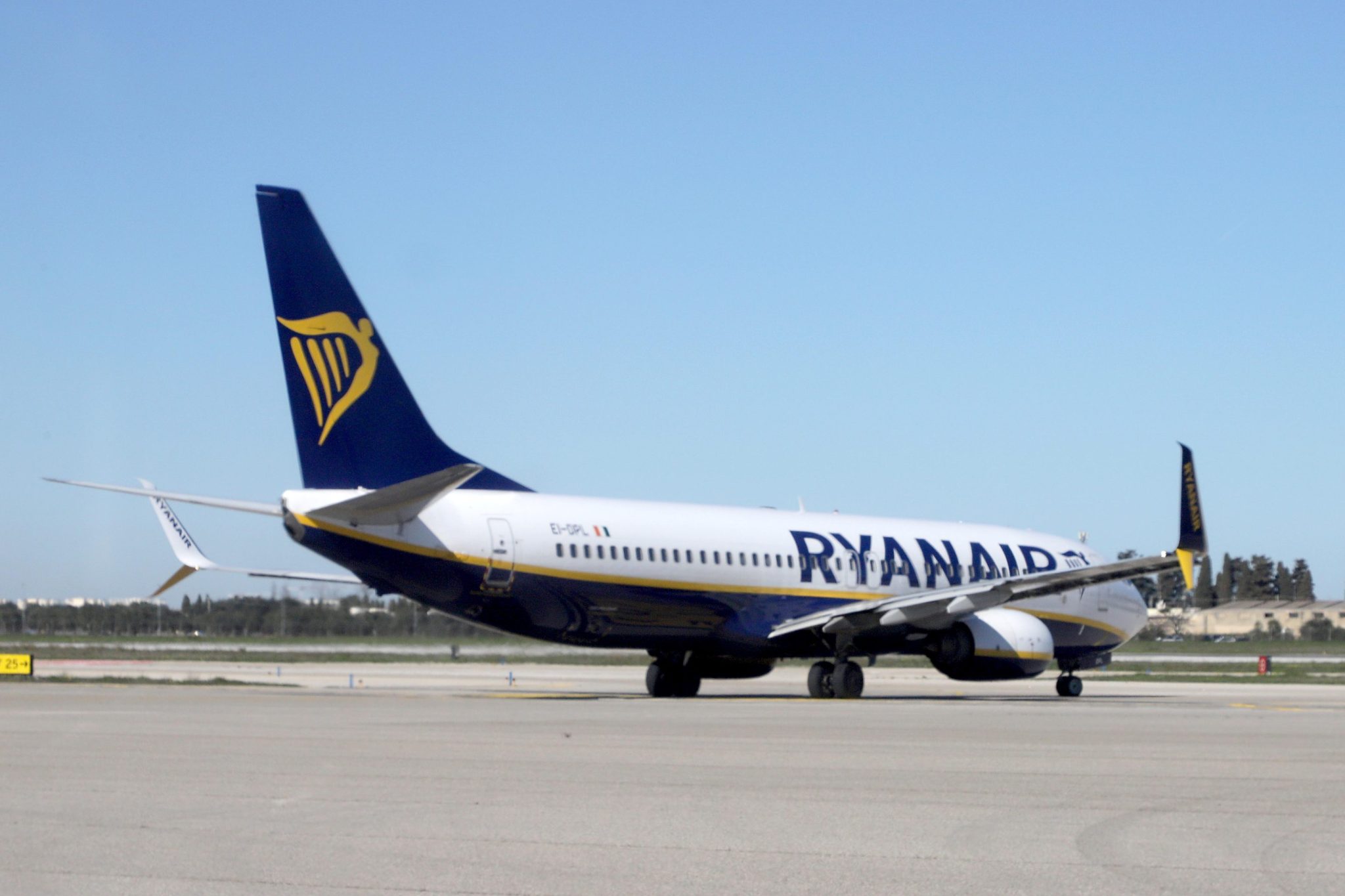
     If the U.S.-Israel war on Iran continues into the summer, then airlines will start running out of jet fuel and will be forced to trim flights, according to Ryanair CEO Michael O’Leary.

    In an interview Thursday with the U.K.’s ITV News, he said carriers will be in an “unknown scenario” if the Strait of Hormuz stays closed for two to three more months, warning 5%-10% of flights in May, June, and July might have to be canceled.

    By that point, O’Leary added airlines won’t be able to choose which flights to cancel, explaining that they will get little advance notice and it would depend on how much jet fuel each airport still has available.

    “So we will then look around, and we will be trying to ground one or two aircraft and minimize the inconvenience for customers,” he said. “But it’s going to be difficult. It’s going to be challenging.” 

    Despite the risk of cancellations, O’Leary said he would “strongly advise” that anyone planning a trip this summer book as soon as possible, before airfares get pricier.

    In fact, jet fuel prices have soared even higher than gasoline prices have as the Iran war has not only bottled up one-fifth of the world’s oil supply but a big chunk of the refining capacity that churns out jet fuel.

    The U.S isn’t immune either, and top airport hubs like Chicago, Houston, Los Angeles and New York have seen the average price for a gallon of jet fuel hit $4.88 per gallon, nearly double compared to the prewar price.

    As a result, more airlines are hiking fees for checking luggage, and United Airlines is bracing for a prolonged war that sends oil as high as $175 a barrel and is making contingency plans that include reducing capacity.

    When asked if booking a flight now would be a gamble given the possibility that a flight may not exist this summer, O’Leary replied he doesn’t think so.

    “Life is a gamble,” he added. “I think we’re looking at maybe the risk to 5 or 10% of cancellations in June or July, but 95-90% of flight will still operate. So I think you’re really not taking much of a gamble. I would be much more concerned if you delay your booking, that actually you and your family will be paying much higher prices.”

    O’Leary acknowledged that travelers who face canceled trips wouldn’t be able to get refunded as airlines could claim circumstances beyond their control.

    But he pointed out anyone flying within Europe won’t be stranded and is entitled to have airlines reroute a trip or get them back home.

    “At Ryanair, we have lots of flights on a daily basis. We will re-accommodate you, get you back, get you out, whatever it’s going to be,” O’Leary vowed. “You might be stuck for a day or two. But if you’re staying within Europe, you should be reasonably confident that, A, your original flight will operate and, B, if there is a disruption, bear in mind there’ll be far more disruptions this summer from French air traffic controllers not showing up to work.”


    Source link

  • Trump’s tales are still muddling markets


    Continuation of the Middle East war is sapping hopes of a return to more normal conditions after the conflict


    Source link

  • Japan cracks down on its wayward cyclists


    Enforcement regime will levy fines for infractions including using headphones and riding with one hand


    Source link

  • Go to court and lose out on £9bn car finance redress scheme, says FCA boss


    Comments by Nikhil Rathi position watchdog for stand-off with claims management companies and law firms


    Source link

  • The shadowy group claiming attacks around Europe


    Ashab al-Yamin, which uses Iran-linked Telegram channels, has taken responsibility for assaults on ambulances, a synagogue and banks


    Source link

  • Trump makes fresh Iran threat as fighter jet crew member remains missing


    US president threatens to rain ‘hell’ down if Strait of Hormuz does not reopen within 48 hours


    Source link

  • Trump sons to Gulf states: we’ve got some drone interception tech to sell you

    Trump sons to Gulf states: we’ve got some drone interception tech to sell you


    A drone maker backed by President Donald Trump’s two oldest sons is trying to sell to Gulf countries while they are under attack by Iran and dependent on the U.S. military led by their father.

    The sales drive by Florida-based Powerus – which announced a deal last month to bring aboard Eric Trump and Donald Trump Jr. – positions the company to potentially benefit from a war that their father began.

    “These countries are under enormous pressure to buy from the sons of the president so he will do what they want,” said Richard Painter, a former chief White House ethics lawyer under President George W. Bush. “This is going to be the first family of a president to make a lot of money off war — a war he didn’t get the consent of Congress for.”

    Powerus co-founder Brett Velicovich told The Associated Press that the company is making sales pitches that include drone demonstrations in several Gulf countries to show how its defensive drone interceptors could help them ward off Iranian attacks.

    “Our team is doing many demos across the Middle East right now for our interceptors,” Velicovich said in an text exchange. “We have very incredible tech that can save lives.”

    He declined to name the countries or give more details.

    The Trump brothers’ deal with Powerus could give them sizable equity stakes. Their father, as commander in chief, launched the strikes with Israel against Iran over a month ago that began the war, the impetus for why these Gulf countries now need protection.

    Powerus denied there were any conflicts when the Trump brothers’ stake was first announced. Velicovich emphasized its determination to help the U.S. catch up with Chinese and Russian drone makers and beat them.

    “We are at war, my friend, we are in an arms race and America will lose if we don’t build fast,” said Velicovich, an Army veteran who had come under fire from the same Russian drones now being used by Iran. He added, “We should be thankful anyone is trying to invest in American manufacturing now. That idea transcends politics.”

    The president’s oldest sons have expanded their business interests beyond hotels and golf courses since their father took office again. The companies they’ve invested in or been named advisers for — with equity stakes — run the gamut from cryptocurrency ventures to prediction markets to federal contractors making rocket parts and rare earth magnets.

    This latest Trump venture has its sights on $1.1 billion set aside by the Pentagon to build up a U.S. manufacturing base for armed drones to fill a hole left when the Trump administration banned such imports from China.

    The Trump Organization, where the two sons are executives, didn’t respond to a request for comment, but has dismissed claims of conflicts of interest in the past. The sons have said they didn’t get credit for their restraint in expanding their businesses in their father’s first term so have decided not to hold back much this time.

    Asked about potential Powerus conflicts of interest specifically, Eric Trump sent AP a statement last month saying, “I am incredibly proud to invest in companies I believe in. Drones are clearly the wave of the future.”

    Founded by U.S. Army Special Operations veterans about a year ago, Powerus makes drones for commercial uses, from spreading fertilizer to putting out forest fires. But it is bulking up fast to supply drones for military uses.

    The company recently raised $60 million from investors and hopes to tap additional financing by doing a “reverse merger” with a Trump company listed on the Nasdaq stock exchange that owns a few golf courses in Florida. Such a merger allows a private business to quickly go public by taking over a company that already has publicly traded shares, shortening the process of filing paperwork and meeting various requirements of regular initial public offering.


    Source link

  • Breakeven hiring negative: The economy can shed jobs and still keep the unemployment rate flat

    Breakeven hiring negative: The economy can shed jobs and still keep the unemployment rate flat


    The most closely watched U.S. economic indicators have turned upside down as President Donald Trump’s immigration crackdown sends the labor force into reverse.

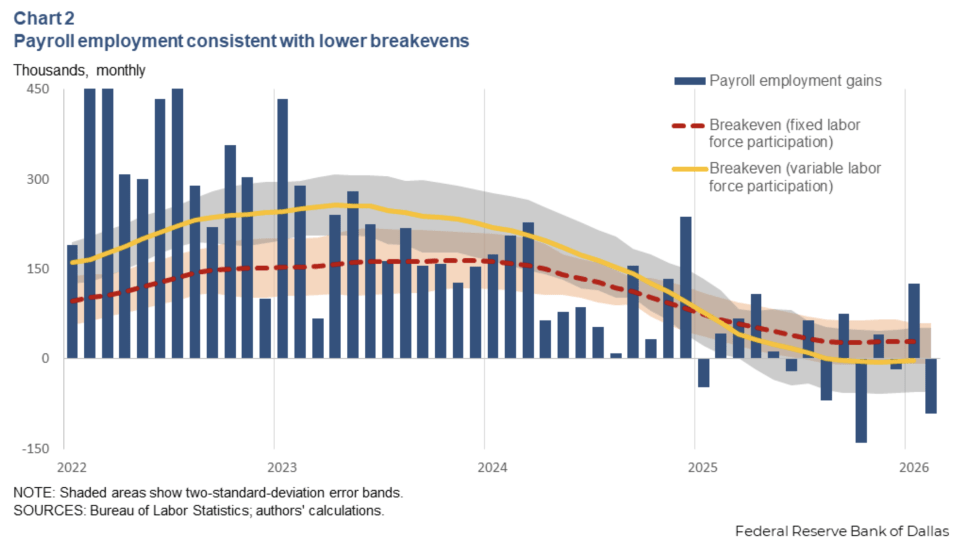
    According to a report from Dallas Fed economists on Tuesday, the breakeven rate of employment growth, or the number of net new jobs needed each month to keep the unemployment rate steady, actually went negative during the summer and fall of last year.

    That means the economy can shed jobs without lifting the jobless rate, signaling an overall balanced labor market despite a lack of net hiring.

    For years, monthly job gains of around 125,000-150,000 were considered necessary to absorb new entrants into the workforce. But with the collapse of net immigration into the U.S., the size of the labor force has stagnated.

    Meanwhile, Trump’s trade war last year and war on Iran this year have created economic uncertainty that’s fueling a low-hire, low-fire job market. But a negative breakeven rate could make a no-hire, low-fire market sustainable.

    Drawing on data in immigration court records and revised estimates of self-deportations, the Dallas Fed economists calculated that net unauthorized immigration was negative in the second half of 2025, averaging -55,000 per month.

    As a result, total net unauthorized immigration for 2025 reached -548,000, about 50% more than the Congressional Budget Office’s latest projection of -365,000.

    “Incorporating these updated estimates of net unauthorized immigration into our full model—allowing the labor force participation rate to vary over time—yields substantially lower break-even employment growth than previously estimated,” they wrote. “The breakeven rate peaked at about 250,000 jobs per month in 2023, fell to roughly 10,000 by July 2025, and declined to near zero thereafter, averaging about –3,000 jobs per month from August to December 2025, indicating, if anything, a modest net jobs loss over this period.”

    Coinciding with the immigration crackdown, labor force participation has also been in a gradual decline. And Friday’s jobs report showed another drop in participation, helping the unemployment rate dip. The declines were concentrated among men in their 20s and 30s, women between ages 20 and 24, and men over 55.

    While the Dallas Fed economists noted it’s difficult to single out factors for the decline, other research has shown that immigrant worker flows boosted employment one for one in recent years.

    The report’s findings carry major implications for the Federal Reserve, which is charged with pursuing maximum employment and price stability.

    Fed Chairman Jerome Powell has pointed to the unemployment rate as a key gauge of the labor market. Despite last year’s dive in average monthly payroll gains, the jobless rate has barely moved and remains at historically low levels, leading the Fed to proceed cautiously with interest rate cuts.

    In fact, the 4.3% unemployment rate in March was little changed from the 4.2% rate in February 2025, Trump’s first full month back in the White House.

    “Real-time data point to an important change in the U.S. labor market: The benchmark for evaluating payroll growth has moved significantly,” the Dallas Fed economists said. “As net outflows of unauthorized immigrants reduced employment growth in late 2025, payroll gains that might historically have signaled economic slack are now consistent with a balanced labor market.”


    Source link